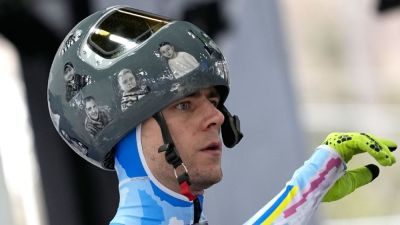


A Ukrainian athlete was banned for his helmet. How does the IOC enforce its rules on political statements?
The Olympics have long been a platform for political posturing, with countries boycotting or being banned over geopolitical conflicts.
But the International Olympic Committee (IOC) says the politics should stop once the games begin — keeping the competitions and podiums free from political "interference."
But what constitutes interference can be complicated.
Even after the IOC on Thursday banned Ukraine's Vladyslav Heraskevych — for wearing a helmet adorned with pictures of war victims — president Kirsty Coventry teared up while explaining the decision, saying while the helmet broke the rules, she did not disagree with its "powerful" message.
Heraskevych, a skeleton competitor, defied the IOC after being told he couldn't wear the helmet, which depicts Ukrainian athletes killed by Russia — a country that’s been barred from the Olympics since its 2022 invasion of Ukraine.
Why did the IOC ban Vladyslav Heraskevych helmet at the Winter Games?
While the decision prompted an outcry from Heraskevych’s teammates, an Olympic historian says it's consistent with a strict interpretation of the rules.
“On the one hand, it's a memorial to fallen comrades. It's also a pretty explicit political statement about the nature of that war," said Bruce Kidd, a former Olympic runner and a professor emeritus at the University of Toronto, who writes about the history and political economy of sports.
Athletes are allowed to make political statements outside the field of play and ceremonies, including at news conferences and on social media. Some have taken advantage of that this year — notably, several American athletes who criticized their own country with anti-ICE messages.
But Heraskevych says the rules were applied unfairly to him,
Related News