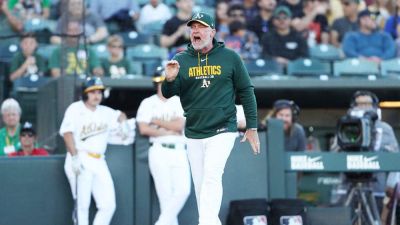


Major League Baseball's Over-35 Hitters Face Steepest Production Drop-Off in Decades
Nolan Arenado was slugging his way through the month of May when the Arizona Diamondbacks third baseman woke up one morning with an ailment that's familiar to those who felt invincible in their 20s but have advanced to their mid-to-late 30s.
His back hurt.
Not bad. Not enough to keep him out of the lineup. But it was one of those inexplicable moments that comes with being an aging Major League Baseball player — threatening to derail a hot streak for an eight-time All-Star who just turned 35.
"There's more aches and pains," Arenado said. "There's just a little more work in the gym, getting prepared for the game, than there used to be. That's a learning curve.
"I've always been in the gym, always did that stuff, but there's definitely more maintenance."
Arenado got past the minor back issue and is continuing a bounce-back season in the desert, batting .256 with eight homers and 30 RBIs through Monday's games. He's among a group of the 35-and-older crowd getting solid results at the plate, joining Los Angeles Dodgers veterans Freddie Freeman and Max Muncy, along with Houston's Christian Walker.
But it's a small club that's become smaller over the past decade.
MLB hitters who are 35 or older have combined to provide just 5.6 WAR (Wins Above Replacement, per FanGraphs) through roughly the first 1/3 of the season, continuing a trend that's accelerated over the past decade.
In the early 2000s, older stars were the norm in the big leagues. It peaked in 2003 when older hitters combined for 71.3 WAR, with a group highlighted by Barry Bonds, Frank Thomas, Kenny Lofton, Luis Gonzalez and Jeff Bagwell.
So what's changed?
Let's look at some of the reasons why MLB is skewing younger this days:
Baseball's analytical era can be traced
Related News