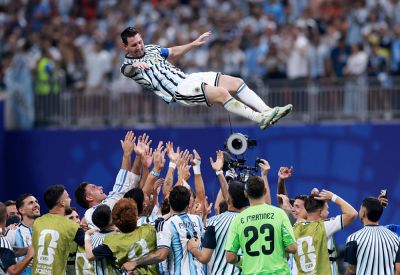


It’s all in the numbers: Expanded World Cup brings more shocks, but heavyweights still rule
BOSTON, USA: The expanded 48-team World Cup has made giant-killings significantly more likely, according to experts, but the longer and more demanding tournament still favors the traditional heavyweight sides best equipped to sustain their level through five knockout rounds.
FIFA expanded the tournament from 32 to 48 teams, adding more than 10 days to the schedule. A newly created round of 32 means teams must now survive an extra knockout match to lift the trophy, while eight third-placed finishers from the group stage advanced, creating more potential pathways for lower-ranked sides.
“We have an additional knockout match where the stronger teams will have a chance of one in three, one in four, one in five to proceed.
This is the additional risk you get for the serious contenders to be kicked out,” Achim Zeileis, Professor of Statistics at Universitaet Innsbruck, told Reuters. “So it’s reduced to 80 percent or 75 percent of the probability they had without this additional problem.”
Zeileis, part of an international team of researchers using machine-learning models to simulate every possible World Cup match, said the revised group stage also introduces new uncertainty.
With eight of the 12 third-placed teams progressing, the final round of group matches becomes more strategically complex, with teams able to react to earlier results while permutations over potential opponents multiply.
“So the eight out of 12 (groups) is the much more serious problem because it gives you this time dependency problem that later group matches can strategically react to the earlier group matches, and they also lead to these many permutations that some top-ranked teams play against third-ranked teams, but they don’t know which one.”
The
Related News